Watergate happened in 1972. Disney+ launched in 2019. I’m going to start somewhere in the middle, with the publication of Marvel Super Hero Contest of Champions in 1982. (I had reached that series in a read-through of some of the comic book collected editions I started acquiring during the pandemic shutdown.)
Follow along!
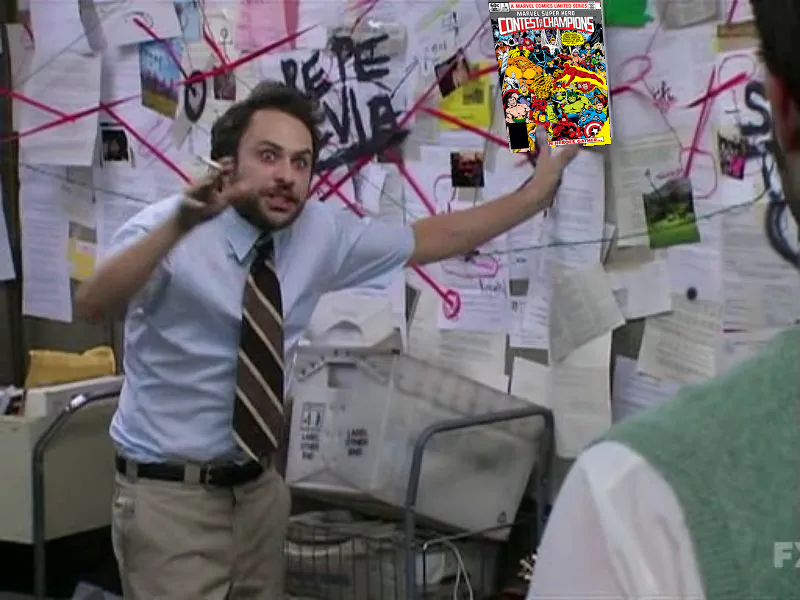
Contest of Champions was Marvel’s first published limited series: three issues, cover-dated June through August 1982. A limited series has an ending planned from the outset, which is a useful distinction in a business where defeating your archenemy usually means he’ll be back in time for another subscription renewal. The story gathered an enormous collection of Marvel heroes, then selected teams to compete on behalf of the Grandmaster and a mysterious opponent who turned out to be Death. The prize involved bringing the Grandmaster’s brother, the Collector, back to life.
The story was okay enough. The sales were another matter. Marvel had demonstrated that putting its heroes together in a separate, finite series could be an event in its own right. That success led Marvel honcho Jim Shooter to go bigger with the twelve-issue limited series Secret Wars in 1984–85. Heroes and villains were taken to Battleworld, where the Beyonder encouraged them to settle their differences through violence.
Mattel helped make it happen. Their rival Kenner had licensed DC’s characters for an action-figure line, and Mattel wanted Marvel’s heroes and an event to promote them. Fan requests supplied the everyone-in-one-story idea; market research supplied words children liked: “secret” and “wars”. Cosmic mysteries are easier to explain when somebody needs to sell a playset.
Secret Wars was a hit, and its success cemented Shooter’s honchosity. The big crossover became a recurring attraction: gather the stars for a story too large for any one of their regular titles. That model gave us later events including The Infinity Gauntlet in 1991 and Civil War in 2006–07.
Then the Marvel Cinematic Universe (MCU) movies borrowed the stories and the attraction. Captain America: Civil War brought the superhero split to the screen in 2016. Avengers: Infinity War and Endgame brought Thanos and the Infinity Gauntlet material to the climax of the MCU’s Infinity Saga. Audiences followed characters from their individual films into enormous shared adventures.
The MCU’s success gave Disney both the audience and the incentive to bring those viewers to its own streaming service. Why license the movies to Netflix when Disney could sell the subscriptions directly? Disney announced its streaming plans in August 2017, and Disney+ launched November 12, 2019.
So far, so good. Where’s Watergate?
Back at the beginning, hiding behind the Olympics. Contest of Champions started as an oversized comic planned around the 1980 Moscow Summer Games. Its international competition explains a cast that included heroes such as France’s Peregrine, Ireland’s Shamrock and Argentina’s Defensor. But when the United States boycotted the Games, Marvel shelved the project. It eventually came out as that successful three-issue limited series instead.
The boycott was a response to the Soviet invasion of Afghanistan in December 1979. The Soviets wanted to preserve a friendly government on their border, and the Iranian Revolution had unsettled the region. Meanwhile, Vietnam and especially Watergate had weakened America’s standing and willingness to intervene abroad. Moscow saw political instability in the U.S. and perceived American weaknesses in the Cold War, which made aggressive moves more tempting.
So Watergate helped create the opening for the invasion, the invasion prompted the boycott, the boycott left Marvel with a shelved Olympic comic, and that comic became a successful publishing experiment. The experiment led to bigger events, the events supplied blockbuster movies, and the movies helped lead Disney to your monthly subscription payment.
Thanks, Nixon.
Part Two: Checking the Connections
Now let’s go back over a few of those connecting arrows. I told that as one continuous chain, giving a disputed recollection, a business inference and a documented response the same confident delivery. They don’t actually have the same confidence.
Let’s start with the biggest stretch: Watergate. A 1980 Congressional Research Service report records Saudi and other Gulf media interpreting Soviet intervention in terms of American weakness after Vietnam and Watergate. That establishes that people made the connection at the time. It doesn’t establish that Watergate drove the Soviet decision, or that Moscow reasoned through the opening exactly as I just described.
The archival history puts much more weight on Afghanistan’s rebellion and leadership struggles, Soviet distrust of Hafizullah Amin, and fear of losing a neighboring client state. Iran complicated the picture: Soviet leaders worried that the United States might seek a foothold in Afghanistan after losing its position in Iran. Some of their suspicions about Amin’s American connections were unfounded. A December 1979 US diplomatic assessment discussed removing Amin and circumstances that might reduce the perceived costs of intervention, but it was preliminary and didn’t mention Watergate. The first arrow is doing a lot of work.
The invasion-to-boycott connection is much firmer. So is the boycott’s effect on the comic, described by both Steven Grant and Tom DeFalco. Even there, Shooter’s later recollection introduces Olympic licensing costs. The production history has more moving parts than one cancelled tie-in, and the boycott changing this project’s path doesn’t mean Marvel would otherwise never have tried a limited series.
The next connection has witnesses who disagree. Grant thought Contest of Champions‘ success helped get Shooter thinking about Secret Wars. DeFalco also described it as a model. Shooter, asked whether one germinated into the other, said no. His own origin account emphasizes Mattel and fan requests.
Nor did Secret Wars invent crossovers or dictate decades of publishing decisions. It helped establish a commercially successful model. The later comics had their own creators and circumstances, and the films adapted selected ideas into different stories. Infinity War and Endgame drew on The Infinity Gauntlet; they didn’t just put its panels on screen.
Finally, Disney+ had more parents than the MCU. Disney’s 2017 announcement described a broader direct-to-consumer strategy, supported by acquiring control of streaming company BAMTech. Its Netflix agreement for new theatrical releases would end with the 2019 slate; this wasn’t simply Netflix taking a cut of Disney subscriptions. At launch, Marvel shared the service with Disney, Pixar, Star Wars and National Geographic. Marvel gave Disney a substantial attraction, but saying its success caused the service compresses a much larger decision.
I’m prepared to credit Richard Nixon with an extremely indirect connection to Disney+; I’m less prepared to give him a producer credit.
—jhunterj