When a background job fails or an external request times out, you need enough diagnostic detail to understand what went wrong. The easiest engineering response is to dump the entire payload or session state into the log so you never miss anything. If your application handles personal data like resumes, employment history, notes, or contact information, that quick decision turns a temporary error into a permanent, unreviewed copy of the user’s private records sitting in plain text across your logging pipeline.
Useful troubleshooting does not require capturing someone’s life history; it requires knowing which step failed, under what conditions, and with what failure category.
| What helps diagnosis | What creates risk |
|---|---|
| Operation phase and normalized step name | Full request or response payload |
| Fixed error classification and HTTP status code | Freeform error strings containing user inputs |
| Bounded counts and elapsed execution time | Document contents, raw text, or pasted notes |
| Synthetic, user-scoped correlation identifier | Plaintext personal names, emails, or phone numbers |
Logging full payloads usually starts as a temporary debugging aid during development. A developer turns on verbose logging to diagnose an elusive edge case, commits the configuration, but the verbosity stays enabled when code reaches production. Even when log access is restricted to engineering staff, logs travel through centralized log aggregators, backup archives, local terminal buffers, and third-party monitoring vendors. Once sensitive data enters those streams, deleting or purging it across distributed log retention buckets is significantly harder than filtering it at the point of origin.
You can preserve operational visibility while keeping sensitive data out of logs by enforcing four boundaries at the reporting layer:
- Log the phase, not the text: Record structured markers such as
phase: "document_extraction"anderror_type: "timeout". You do not need the text of the resume or cover letter to recognize that an upstream parser timed out after 30 seconds. - Normalize error categories: Map provider responses and exceptions into a bounded set of application error codes rather than passing through vendor strings that echo user data back in error messages.
- Use synthetic correlation IDs: When you need to trace an operation across services or find related entries, generate an opaque, random correlation identifier. Link the steps with that token instead of logging filenames, email addresses, or database primary keys that identify the individual.
- Enforce payload truncation and key allowlists: If a diagnostic report must include metadata, configure serializers with strict allowlists for permitted scalar fields (like file size in bytes, MIME type, or retry count) rather than relying on blocklists that can miss newly added fields.
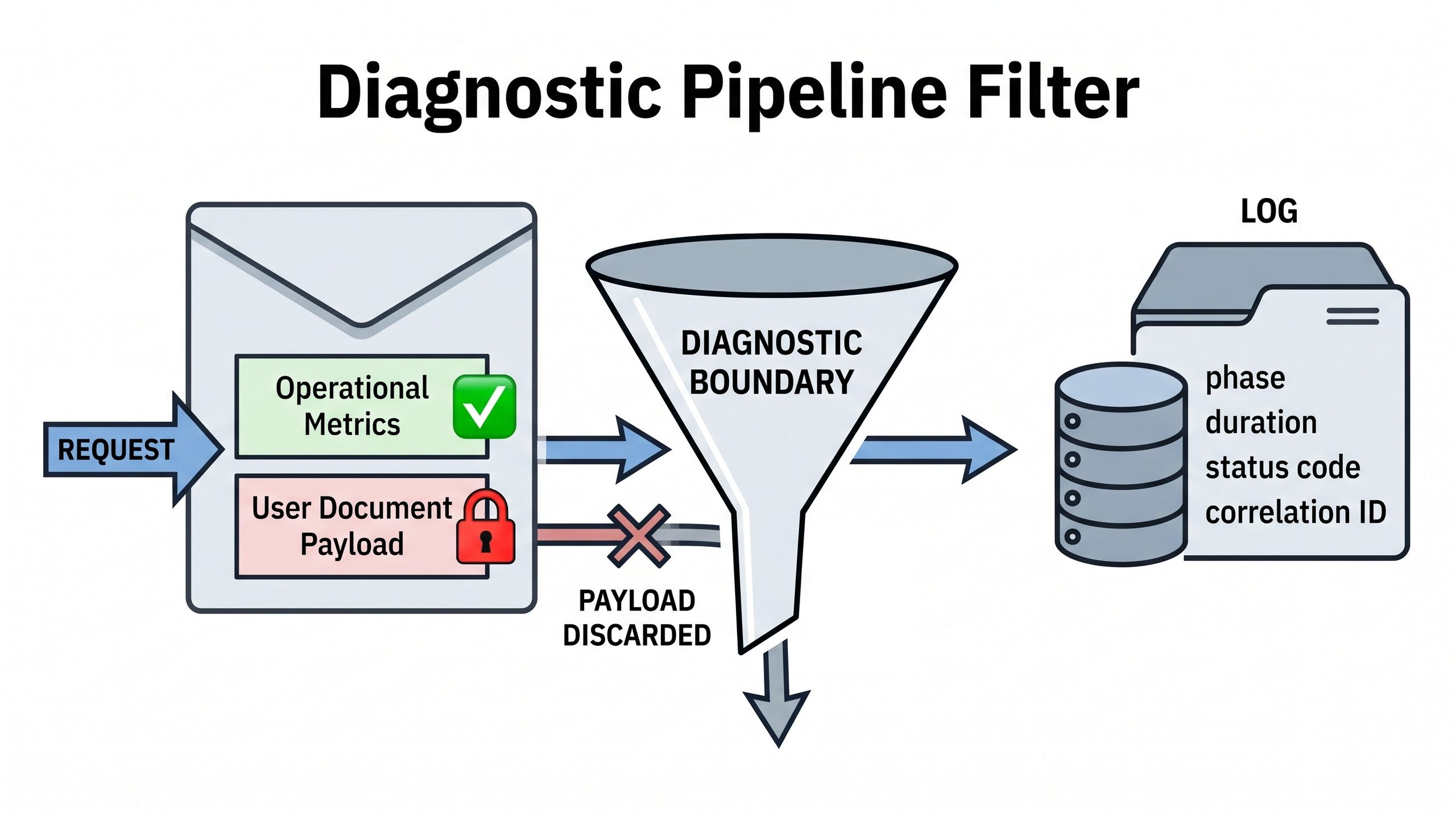
When users request diagnostic support or ask you to investigate a failed transaction, provide a user-facing review step before sharing diagnostic packages. A small export screen showing the exact key-value pairs being submitted lets the user see what is included and confirms that no private document contents are attached.
Next time you write an error handler or configure an application logger, define the minimal diagnostic facts required to fix the failure; if a field contains user content rather than operational metadata, leave it out of the log.
—jhunterj