Getting a sorceress into a board game involved learning Lua, baking textures in Blender, and explaining to an AI assistant that “Add one kill per Hero Stone” was an important distinction.
I adapted Goblin Slayer, a board game by Rich Carlson and Iikka Keränen, for Tabletop Simulator. It gave me a concrete reason to learn some unfamiliar tools, with existing rules and artwork, a clear idea of what players should be able to do, and plenty of repetitive work worth automating. My software development background helped me frame the problems; Google Gemini and NotebookLM helped me work through documentation, scripts, and unfamiliar interfaces.
I say “adapted”, but like any creative work, it’s never done, just released. I’ve recently set up a Codex project to continue the work I started in Gemini and NotebookLM.
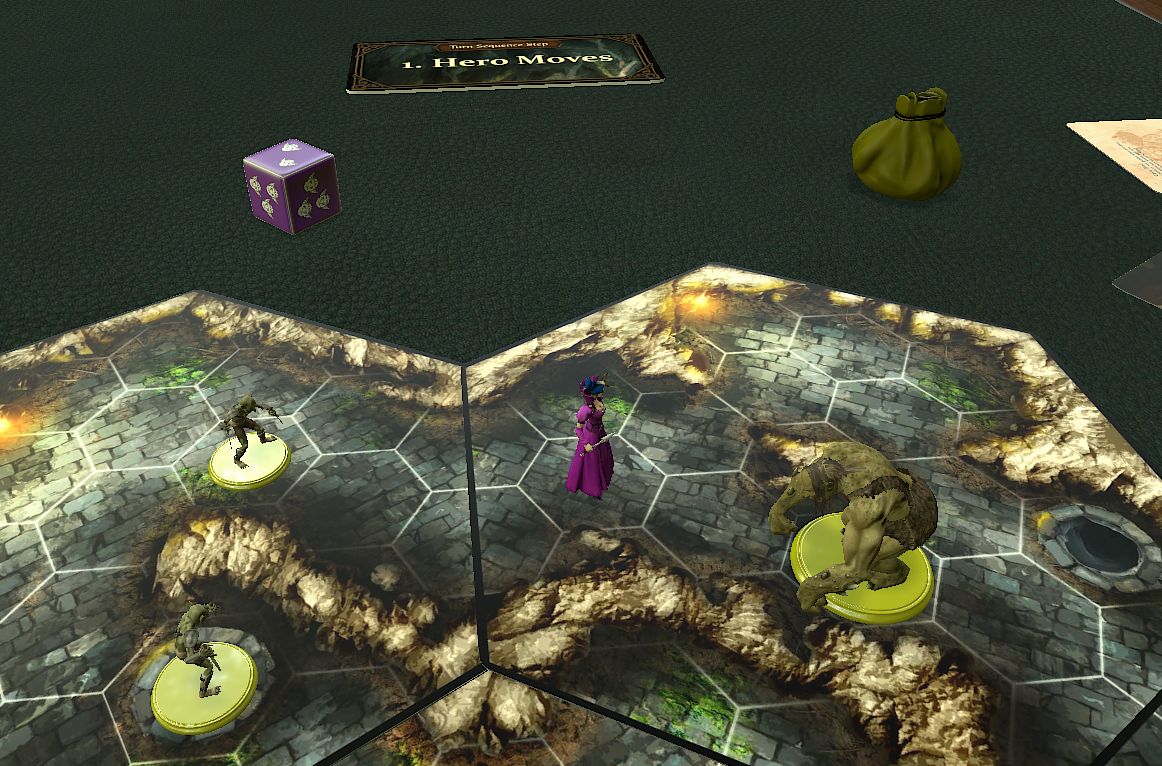
I started with setup. The board has modular cave tiles that are rearranged between games, along with pieces, treasures, cards, and accessories to place or put away. Switching between Stormbeard the dwarf and Mirelle the sorceress also changes the equipment the player needs. I developed Lua scripts to handle that work, then added a turn-sequence marker and color changes to identify monsters that had been picked up or affected by Mirelle’s Bubbles & Butterflies spell. The players make the decisions while the scripts handle some of the bookkeeping.
That meant learning how Tabletop Simulator represents objects and responds to events. A figure changing state or a card entering a discard zone can trigger behavior, but I still had to decide what should happen and when. Loading a saved game should preserve its progress; starting a new game should rearrange the board. Confusing those two is a very efficient way to destroy a carefully arranged position.
AI assistance let me ask focused questions, try the answers in the game, and come back with what actually happened. My existing experience helped, but it didn’t tell me which events Tabletop Simulator would fire or what state an object would be in when my script ran. I had to learn those details.
The 3D work took me farther outside my usual territory. I had flat artwork of Mirelle and wanted a sculpted figurine. Tripo generated a model with eleven separate texture images. Getting it into Tabletop Simulator meant learning enough Blender to combine that texture information into one image and reduce the model’s complexity.
Some questions were about concepts; others were about finding the correct menu. “Bake the texture” is a useful instruction once you know what baking means, which settings matter, and where Blender has put them. The first model failed to load in Tabletop Simulator. After working through the export and simplification process, I got it imported, with a baked texture and a reduced model of about 24,000 triangles.
The assistance also needed correction. Generated artwork repeatedly missed the exact Hero Stone wording, and development advice included a command my editor didn’t recognize. AI helped me find explanations and produce first attempts, but I still had to check the wording, run the scripts, and load the model. A plausible explanation could get me started; the result in the application determined whether it helped.
It’s an active way to learn: work on something I want to finish, ask questions as I encounter unfamiliar parts, and develop enough understanding to judge the answers. The questions get better as the work progresses.
The Goblin Slayer adaptation is available on Steam Workshop. Mirelle made it to the table.
—jhunterj